Drying trays and flexible packaging in the food industry
The water that remains on the surface of a tray or flexible package after washing or a previous process is not a minor issue. It can cause poorly adhered labels, defective seals, limescale marks, bacterial growth and quality-control rejections. On high-speed food production lines, the problem becomes even more significant, as there is no room for manual drying or production stoppages.
At Bcnvision Group, we solve this issue with AirDryer Tray, a drying system specifically designed for tubs, doypacks, trays and other flexible packaging that needs to reach the next stages of the process completely dry.
Why drying flexible packaging is a critical point in food production
Flexible packaging often has an irregular geometry, with folds, corners and curved surfaces where water can easily accumulate. Unlike a bottle or can, there is no uniform surface that a generic drying system can treat evenly.
When residual moisture reaches the labelling stage, labels may fail to adhere properly and can peel off during transport or on the retail shelf. When it reaches the sealing stage, it can compromise seal integrity and reduce the product’s shelf life. And when wet packaging is stacked, the risk of cross-contamination and mould growth during storage increases.
Traditional compressed-air drying systems consume large amounts of energy and do not always reach the upper, lower and side surfaces of the package with the same effectiveness. This is where a system specifically designed for flexible geometries makes a real difference.
How AirDryer Tray works
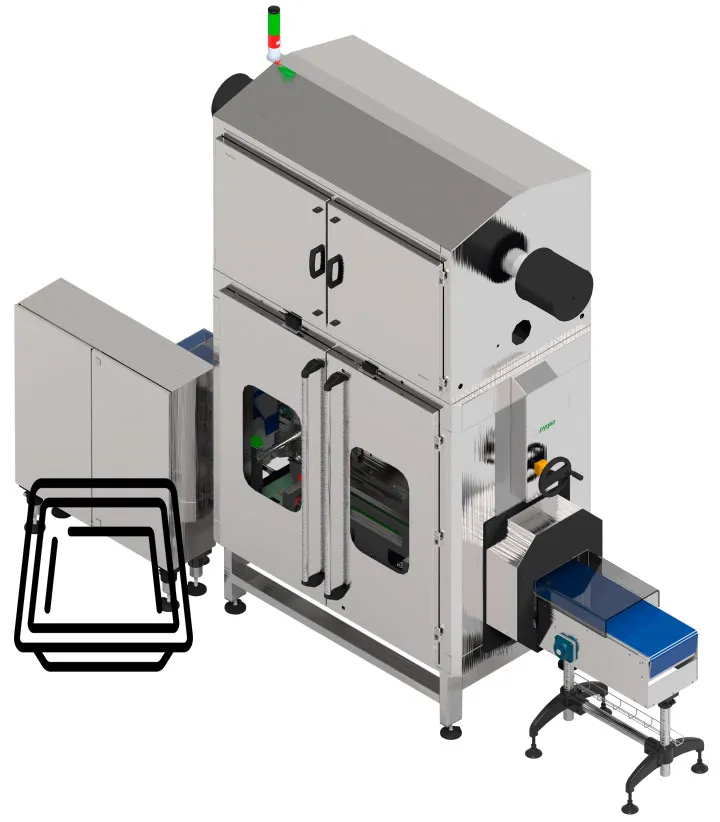
AirDryer Tray removes surface water from tubs, doypacks, trays and similar packaging by acting simultaneously on the top, bottom and sides, continuously and without stopping the production line. The result is a completely dry package, ready for subsequent packaging or labelling operations.
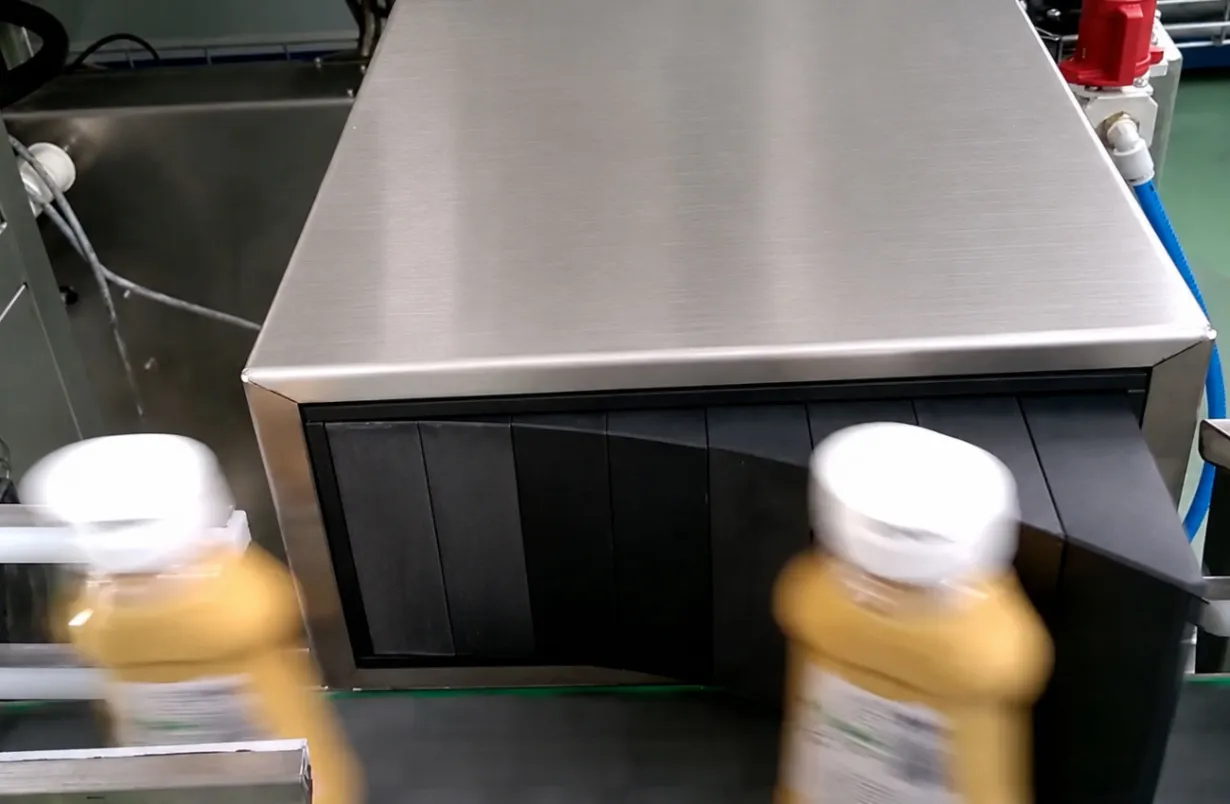
The blower is positioned at the top of the system, improving acoustic insulation and protecting the component from external agents. Air-jet plates distribute the airflow evenly across the entire surface of the package, achieving an efficient sweeping effect that other systems cannot deliver with the same installed power.
The entire unit is enclosed to contain noise and splashes, with front windows for process monitoring, access doors with safety glazing and an internal washable acoustic-insulation lining. Noise levels remain below 80 dB(A), meeting occupational health and safety requirements both around the motor and in the drying area.
With a total length of just 1,600 mm, it is one of the most compact systems in its category, making it easy to integrate into existing production lines without the need to redesign the production layout.
A system designed to reduce energy costs
One of the areas where AirDryer Tray stands out most is energy consumption. Compared with traditional compressed air, it provides between 40% and 60% higher airflow with lower installed power, resulting in savings of up to 90% in operating costs over the lifetime of the equipment.
Maintenance is limited to the periodic replacement of belts and filters, and the system is available in stainless-steel finishes, with aluminium air knives as an option for applications that require them.
Format height adjustment can be manual or automatic, allowing the system to be adapted to different package sizes without losing time during format changes.
Frequently asked questions about drying trays and flexible packaging
Why is it important to dry flexible packaging properly before packaging or labelling?
Because residual moisture can prevent labels from adhering correctly, compromise seal quality and increase the risk of cross-contamination or mould growth during product storage.
What makes AirDryer Tray different from a conventional compressed-air system?
AirDryer Tray dries the top, bottom and sides of the package simultaneously, with airflow between 40% and 60% higher and significantly lower energy consumption, reducing operating costs considerably compared with traditional compressed-air systems.
Can AirDryer Tray be used with any type of flexible packaging?
It is designed for tubs, doypacks, trays and similar formats with irregular geometries. It can be adapted using manual or automatic height adjustment.
If your food production line has residual moisture issues before packaging or labelling, tell us what type of packaging you handle and what production speed you need to achieve. At Bcnvision Group, we analyse your application and help you size the right drying system.